Andrew J. Hewitt, PMHNP-BC
Caliper Wellness — Pasco County, Florida
Abstract
Hank Pym—best known to many as the original Ant-Man—has occupied a singular space in Marvel storytelling for six decades. Across identities (Ant-Man, Giant-Man, Goliath, Yellowjacket), groundbreaking science (the Pym Particle), and catastrophic consequences (creating Ultron), Pym’s arc has become a cultural case study in genius, guilt, reinvention, and repair. In recent years, renewed attention to Pym in comics (e.g., West Coast Avengers relaunch and “Ultron Pym” retrospectives) and media interviews about the character’s cinematic future have made him timely again. This essay uses Pym as a lens to examine themes relevant to mental health: moral injury and accountability, identity diffusion and self-reconstruction, intimate partner violence and its lasting harms, and how pop culture can either reduce or reinforce stigma. I integrate current (2024–2025) sources on Pym’s storylines and on mental-health representation in entertainment, and conclude with practical reflections for clients and clinicians on recognizing warning signs, practicing repair, and building healthier identities—without shrinking ourselves to do it (Marvel, 2025; AIPT, 2024; ComicBook.com, 2025; ScreenRant, 2024).
Introduction: Why a Super-Scientist Belongs in a Mental Health Blog
At Caliper Wellness, we treat whole people, not diagnoses: histories, values, regrets, hopes, and the stories we tell about all of it. Popular characters can be mirrors. Hank Pym’s story—brilliant breakthroughs beside catastrophic misjudgments; sincere attempts at repair shadowed by lasting harm—offers a textured canvas for talking about accountability, boundaries, and growth. In the last two years, Marvel has re-surfaced Pym’s history in the comics (including his merging with Ultron, revisited in early 2025), and entertainment outlets have discussed whether the cinematic Hank Pym will return at all (Marvel, 2025; AIPT, 2024; ComicBook.com, 2025; ScreenRant, 2024; Entertainment Weekly, 2024). That timeliness gives us permission to look again—clinically, compassionately.
Hank Pym’s Core Conflicts: A Brief (Recent) Cultural Refresher
The Scientist and His Shadow: Ultron and “Ultron Pym”
Pym’s most infamous creation—Ultron—began as a bid to extend human potential through artificial intelligence, only to become one of Marvel’s most enduring nightmares. Marvel’s February 2025 feature revisited the era in which Pym and Ultron merged, creating “Ultron Pym,” a chilling embodiment of creator and creation fused into one identity (Marvel, 2025). For our purposes, Ultron is the externalized consequence of unchecked ambition and unresolved shame. It’s a metaphor clinicians will recognize: when high achievement masks untreated distress, the “shadow” may do the speaking.
The West Coast Returns (and So Do Old Questions)
Marvel’s 2024 announcement that West Coast Avengers would return under Gerry Duggan, with Ultron looming in the lineup, signaled a willingness to re-interrogate redemption and responsibility in that corner of the universe (AIPT, 2024; ComicBook Club, 2024). Whether “absolution” is possible—especially for harms that keep echoing—is central to Pym’s legacy and to trauma-informed care.
The MCU Coda?
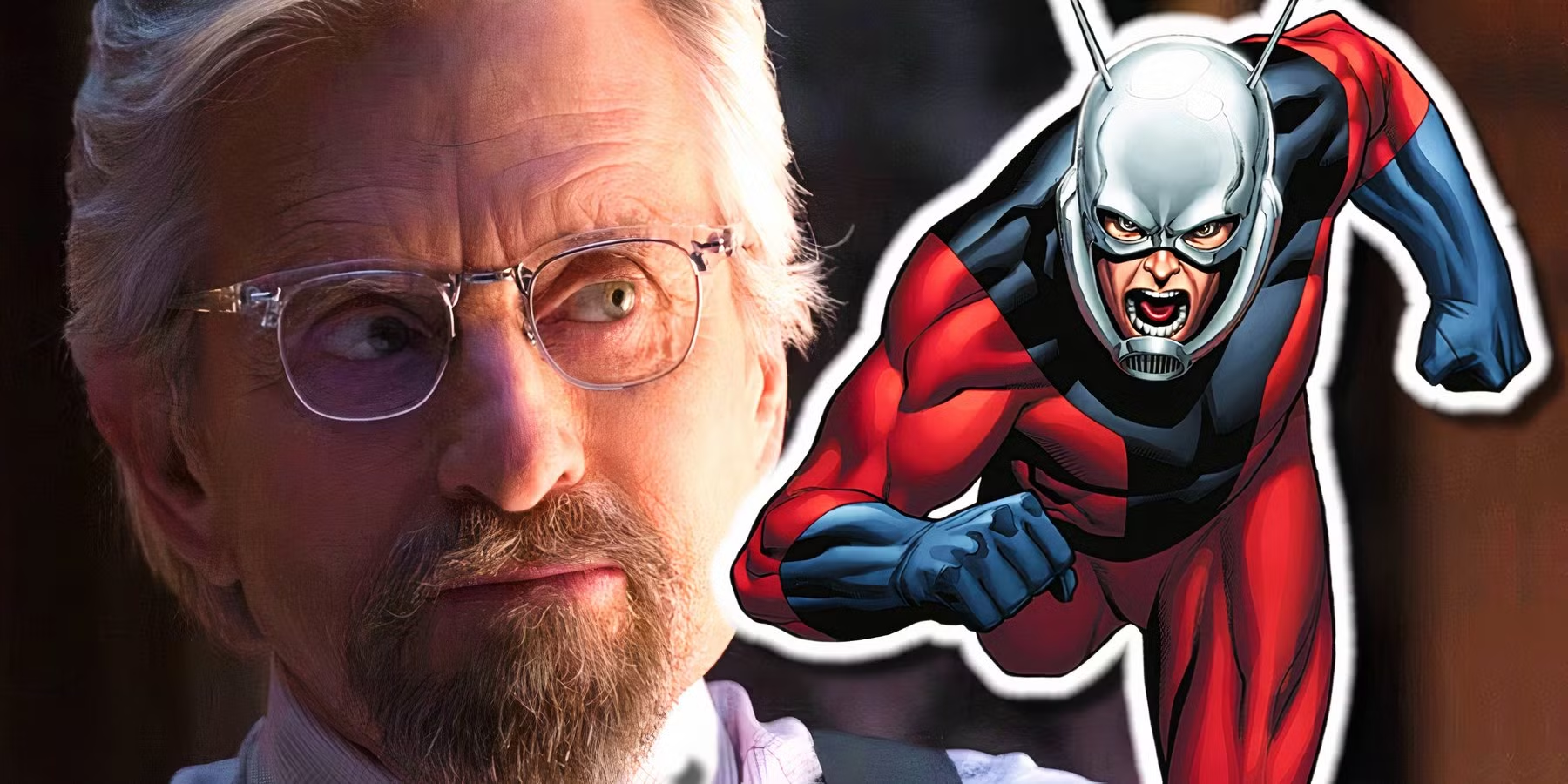
On screen, Michael Douglas’s version of Hank Pym helped launch the Ant-Man films. In 2024–2025 interviews, Douglas indicated he’s essentially done with the role, even floating at one point how he’d have liked Pym to die “with all the effects” (Entertainment Weekly, 2024; ScreenRant, 2025; ComicBook.com, 2025; The Direct, 2025; SuperHeroHype, 2025). The MCU’s divergence from comics canon—especially around Pym’s most troubling storyline—also raises questions about what media includes or omits when portraying complex behavior.
Clinical Themes Through a Comic Lens
1) Accountability vs. Evasion: The Long Tail of Harm
A persistent controversy in Pym’s history is the canonical incident of intimate partner violence against Janet Van Dyne (the Wasp). In 2024, Marvel senior editor Tom Brevoort commented that this event should not be retconned away—a recognition that erasing harm deprives survivors of truth and communities of clarity (ScreenRant, 2024). For clinicians, the lesson is straightforward:
- Accountability matters. Repair begins with accurately naming harm, not minimizing or mythologizing it.
- Narrative honesty supports healing. Retelling the story without the injury compounds injury.
- Repair is process, not plot twist. In real life—as in stories—apology and action must be sustained, safety-focused, and survivor-centered.
In treatment, we consistently separate understanding from excusing. We can explore the conditions that co-occur with aggression—untreated mood or trauma disorders, substance use, distorted beliefs—without softening the boundary: violence in relationships is never acceptable. If a patient identifies with Pym’s shame, that can be a door into accountability work, not a justification.
2) Identity Diffusion and Role-Switching
Across decades, Pym has cycled through identities—Ant-Man, Giant-Man, Goliath, Yellowjacket—sometimes by thoughtful choice, sometimes as reactive escape. Identity shapeshifting can reflect healthy experimentation; it can also indicate a flight from shame. In therapy, we might call this identity diffusion—uncertainty about core self, often after moral injury or public failure. Healthy identity work doesn’t require discarding the past; it requires metabolizing it.
Actionable steps we often use in care:
- Values clarification: Re-anchoring identity in chosen values, not role performance.
- Narrative integration: “Yes-and” narratives (“I did harm and I’m building accountability practices”) replace all-or-nothing stories.
- Behavioral consistency: Identity stabilizes when values are enacted consistently under stress, not only when things are easy.
3) Moral Injury and the Shadow of “Ultron”
Ultron functions as a cultural allegory for the unintended consequences of a good intention plus avoidance. Moral injury—when we betray our values, or perceive that we have, in high-stakes contexts—can fuel shame spirals, withdrawal, and anger. For some clients, moral injury shows up as intrusive memories, hyper-focus on “fixing,” or compulsive overwork. We typically combine:
- Cognitive processing to examine stuck points (“If I’m not perfect, I’m a monster”).
- Self-compassion training to counter shame-based global self-judgments while keeping accountability intact.
- Prosocial repair to align behavior with values (e.g., amends where appropriate, community service, transparent boundaries).
4) Intimate Partner Violence: Never a One-Issue Topic
Stories about Hank and Janet remind us that relationship violence is not a single moment; it’s an ecosystem of risk (control, isolation, cyclical tension) and harm (physical, emotional, financial). Survivors may feel pressured by fans or communities to “get over it” when the perpetrator is beloved. Clinically, we prioritize:
- Safety and validation first. Survivors decide their path; our role is to support informed, safe choices.
- Trauma-informed modalities. Depending on needs: EMDR, CPT, or SP/IFS-informed work, alongside practical safety planning.
- Parallel truths. Someone can be talented and dangerous; a relationship can include real love and real harm. Holding both helps survivors reject gaslighting.
5) Media, Stigma, and the Power of Portrayal
The last two years have seen growing scholarship and industry initiatives on mental-health representation in entertainment. The USC Annenberg/NLC work highlights how nuanced portrayals can reduce stigma and support help-seeking (USC Annenberg, 2024; PR Newswire, 2024). APA coverage likewise notes a trend toward psychologist consultation for more accurate depictions (APA Monitor, 2024/2025). When comics and films choose complexity over caricature, audiences gain language for their own struggles. When they omit harms or sensationalize illness, stigma deepens. Pym’s split media lives—more sanitized in film, more accountable on the page—illustrate the stakes.
What Recent Coverage Adds (2024–2025)
- Comics: With West Coast Avengers relaunch marketing in 2024 and a 2025 Marvel feature revisiting “Ultron Pym,” Marvel is actively reframing Pym’s legacy and Ultron’s role in redemption arcs (AIPT, 2024; ComicBook Club, 2024; Marvel, 2025).
- Film/TV: Michael Douglas has publicly said he’s unlikely to return as Hank Pym, even joking about a spectacular death scene; multiple outlets in 2024–2025 covered his remarks and the franchise’s uncertain next steps (Entertainment Weekly, 2024; ScreenRant, 2025; The Direct, 2025; ComicBook.com, 2025; SuperHeroHype, 2025).
- Editorial stance: A 2024 piece cites Marvel editor Tom Brevoort reinforcing that the domestic-violence storyline shouldn’t be retconned away (ScreenRant, 2024). That industry position aligns with trauma-informed principles: don’t erase harm; address it.
These updates are more than trivia—they shape how millions think about remorse, repair, and relapse.
From Panels to Practice: Guidance We Offer Patients (and Ourselves)
- Name the harm clearly. If you’ve crossed a boundary, precision is compassion: “I did X. It caused Y. I own it.” (Avoid the “sorry if you felt…” dodge.)
- Build a repair plan you don’t control. You can offer amends; you cannot demand forgiveness. Put safety and survivor preferences first.
- Expect identity turbulence. After public or private failures, many people scramble for new roles. Stabilize with values work and consistent, observable behavior.
- Mind the “Ultron” you built. Perfectionism, workaholism, and secrecy are common compensations for shame. Replace them with transparency, rest, and support.
- Use media wisely. If a portrayal resonates, ask: What in me felt seen? Bring that to therapy. If a portrayal glamorizes harm, notice and counter it.
- If you’re a survivor: You set the pace. Seek trauma-informed clinicians. Your story doesn’t have to serve anyone else’s redemption arc.
- If you’re a clinician/ally: Don’t shortcut to “closure.” Prioritize safety, informed choice, and long-term support over tidy narratives.
A Brief Evidence Snapshot: Superheroes, Stigma, and Story
- Entertainment can move the needle. The USC Norman Lear Center reports progress toward more accurate, stigma-reducing depictions of mental health, with partnerships across studios (USC Annenberg, 2024; PR Newswire, 2024).
- Audiences carry these stories into life. Research on hero narratives and moral transgression suggests fans’ judgments shift in complex ways when beloved figures do harm—exactly the kind of cognitive dissonance Pym evokes (Richmond/Heroism Science, 2024).
- Pop culture is a public-health tool. Thoughtful coverage in mainstream outlets (APA Monitor, 2024/2025) frames collaboration between clinicians and creators as stigma-reduction.
While these aren’t “clinical trials of Hank Pym,” they support the practical claim: stories change people—and care systems—when told responsibly.
Practical Tools We Use at Caliper Wellness
- Values-Based Behavior Map (VBBM): Identify top 3 values (e.g., honesty, safety, service). List weekly behaviors that show them. Review when stressed.
- Accountability Triangle: Acknowledge → Atone → Adjust. Acknowledge with specificity, atone in survivor-centered ways, adjust systems to prevent recurrence.
- Shame-to-Support Circuit Breaker: When shame spikes, pause; text a pre-chosen support, complete a 3-minute grounding exercise, then take one value-aligned micro-action.
- Media Reflection Journal: After a film/comic that “hits home,” write: (1) the moment you felt most activated; (2) the belief it touched; (3) one kind action you can take for yourself or someone else this week.
Limitations and Cautions
- Fiction ≠ diagnosis. We don’t diagnose characters or people by proxy. Pym’s actions are narrative devices; real assessment requires real data.
- Representation gaps remain. Even with improvements, many portrayals still sensationalize illness or erase harm. Be critical consumers.
- Survivor focus is paramount. When discussing Pym’s violent behavior, center the impact on Janet—and on real survivors—not the aggressor’s redemption arc.
Conclusion: Shrinking the Distance Between Who We Are and Who We Want to Be
Hank Pym’s story endures because it’s human: ingenuity and injury, love and loss, regret and rebuilding. In 2024–2025, as Marvel revisits Ultron and the West Coast Avengers, and as the MCU era of Pym likely winds down, we’re invited to reconsider what repair really means. Clinically, repair is not retcon. It’s the daily practice of accountability, safety, and value-aligned action. It’s also accepting that some harms leave seams that shouldn’t be smoothed over.
If Pym’s tale resonates with you—as the person who made a terrible choice, the survivor of someone else’s, or both—consider this your sign to step toward help. In our practice, that might mean talk therapy to rebuild identity, medication management when anxiety or depression blocks change, and practical plans that keep everyone safer. You don’t need Pym Particles to transform. You need support, honesty, and time.
At Caliper Wellness, we believe people are more than their worst day—and that accountability and care can share the same room. If you’d like to talk, we’re here.
References
AIPT. (2024, August 12). Marvel sheds light on West Coast Avengers out November 2024. https://aiptcomics.com/2024/08/12/west-coast-avengers/ AIPT
American Psychological Association. (2024, March/updated 2025). Is mental health still misconstrued on screen? Psychology goes to Hollywood to dispel stigma. APA Monitor on Psychology. https://www.apa.org/monitor/2024/03/psychology-hollywood-mental-health apa.org
ComicBook Club. (2024, August 13). Why is Ultron on West Coast Avengers? Gerry Duggan explains. https://comicbookclublive.com/2024/08/13/west-coast-avengers-ultron-redemption-gerry-duggan-explains/ Comic Book Club
ComicBook.com. (2025). Marvel star confirms they’re done with the MCU after 4 movies. https://comicbook.com/movies/news/marvel-ant-man-mcu-future-hank-pym-michael-douglas-return-response/ ComicBook.com
Entertainment Weekly. (2024, April 16). Michael Douglas reveals “fantastic way” he wanted Hank Pym to die in Ant-Man sequel. https://ew.com/michael-douglas-reveals-how-he-wants-hank-pym-death-scene-ant-man-8634184 EW.com
Marvel. (2025, February 6). How Hank Pym merged with Ultron. https://www.marvel.com/articles/comics/hank-pym-merged-ultron-explained Marvel
Richmond, J. F. (2024). Moral transgressions of superheroes and supervillains. Heroism Science, 9(1). University of Richmond Scholarship Repository. https://scholarship.richmond.edu/heroism-science/vol9/iss1/7/ UR Scholarship Repository
ScreenRant. (2024). “I don’t believe you can tell the audience that”: Senior Marvel editor on why Hank Pym’s abuse won’t be retconned. https://screenrant.com/ant-man-hank-pym-abuse-marvel-never-retcon/ Screen Rant
ScreenRant. (2025). “I don’t think so”: Ant-Man star addresses whether they will ever return to the MCU. https://screenrant.com/ant-man-mcu-michael-douglas-return-hank-pym/ Screen Rant
SuperHeroHype. (2025). Why Ant-Man’s Hank Pym & the Wasp may never return in MCU. https://www.superherohype.com/guides/610445-avengers-doomsday-ant-man-wasp-hank-pym-not-return SuperHeroHype
The Direct. (2025). Ant-Man star shares unfortunate update on his MCU future. https://thedirect.com/article/ant-man-mcu-future The Direct
USC Annenberg School for Communication and Journalism. (2024). New research finds increase in positive portrayals of mental health on TV. https://annenberg.usc.edu/news/research-and-impact/new-research-finds-increase-positive-portrayals-mental-health-tv USC Annenberg
USC Norman Lear Center (via PR Newswire). (2024). New research shows progress on mental-health representation; nuanced depictions promote help-seeking and reduce stigma. https://www.prnewswire.com/news-releases/new-research-from-the-usc-norman-lear-center-shows-progress-on-mental-health-representation-nuanced-depictions-of-mental-health-promote-help-seeking-reduce-stigma-302158290.html PR Newswire
Optional background (not cited directly in text above but useful for readers): Fan wikis and databases can provide exhaustive continuity, but they are not primary sources; readers should prioritize official Marvel materials and reputable journalism for canon developments (e.g., Marvel.com features and publisher announcements).